
ThermoWhite® System
Loose-fill insulation: A new way of thinking.
What is the ThermoWhite® System?
Rethink Insulation – with the ThermoWhite® System
ThermoWhite® is an insulation system based on mineral-bonded loose-fill insulation made from recycled EPS – innovative, CE-certified, and versatile.
ThermoWhite® offers a dimensionally stable, closed insulation layer that significantly improves thermal insulation and impact sound. Compared to many conventional systems, the ThermoWhite® system exhibits constant stability along with high load capacity.
Together with selected partner companies in processing, this creates a combination of high product quality, reliable system design, and professional service.
The tested quality of the system is based on several factors:



The Advantages of the ThermoWhite® System




Sustainability of
ThermoWhite® Systems
The ThermoWhite® insulation system, based on mineral-bound loose-fill insulation, is an environmentally friendly alternative to many conventional insulation board systems. The system relies on natural mineral raw materials and recycled polystyrene (EPS), demonstrating that performance and resource conservation go hand in hand.
Sustainability is an integral part of the ThermoWhite® system – not just an additional argument.
- Usage of recycled polystyrene (EPS)
- Operation natural mineral raw materials
- Positive environmental assessment, confirmed by a study from the Institute for Waste Management at the University of Natural Resources and Life Sciences, Vienna
- Awarded the ENERGY GLOBE AWARD 2019
By seamlessly applying our loose-fill insulation, the time-consuming cutting of panels becomes unnecessary. This reduces waste, saves material, and ensures cleaner construction sites. With every project, we, together with our partners, contribute to more resource-efficient construction methods.
A study by the Institute for Waste Management at the University of Natural Resources and Life Sciences Vienna confirms that ThermoWhite® has a positive ecological balance and high environmental compatibility. In comparison to conventional EPS board insulation systems, it shows:
- 75 % less photochemical ozone
- 54 % lower demand for primary energy
- 21 % less CO₂ emissions
- 14 % less water demand
- 12 % lower resource requirements
- 100 % Recycling of Styrofoam waste is possible
Comparison of insulation values with ThermoWhite
Insulation in Theory and Practice:
Installation with ThermoWhite®
(0.049 W/mK)
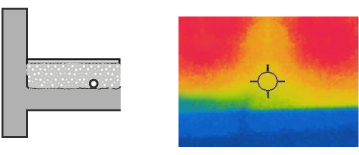
PRAXIS U-value: 0.818
ThermoWhite encases the pipes and completely fills any slots or gaps. This eliminates cold/heat bridges. The calculated U-value is therefore better in practice.
Laying EPS insulation boards
(0.038 W/mK)
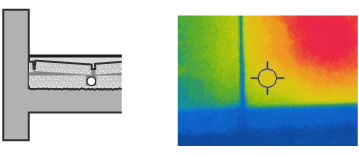
PRAXIS U-value: 0.988
Installing EPS insulation boards on the pipes in the screed ceiling's installation level is time-consuming and inefficient. The U-value is worse in practice than on paper due to the resulting gaps.
Fast and clean:
On-site processing
In five work steps to perfect insulation:
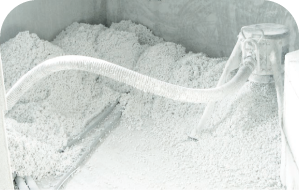
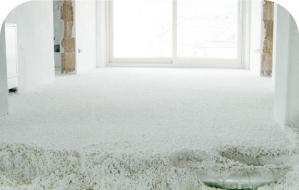
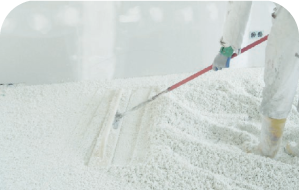
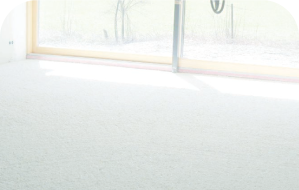
The ThermoWhite® system combines high execution quality with an efficient, clean site process.
Quality & Certifications
ThermoWhite® stands for tested and documented quality. Our systems are continuously monitored and further developed.
- CE-certified products and European approvals
- In-house Production Control with defined test processes
- Self-monitoring and external monitoring by independent institutes (e.g., BVFS, OFI, OIB)
The combination of high-quality binder, recycled EPS granules, and professional processing ensures dimensionally stable, resilient, and permanently functional insulation layers. For our partners, this means reliable characteristic values, clear documentation, and a high degree of planning certainty.
Quality assurance tests according to the required standards:
- Tests according to ETA-17/0407, ETA-12/0428, ETA-17/0408, and ETA-19/0772
- Aggregate size EPS ÖNORM – EN 933-1
- Bulk density of EPS dry mortar ÖNORM – EN 1097-3
- Fresh mortar density ÖNORM – EN 12350-6
- Thermal conductivity ÖNORM – EN 12667, ÖNORM B 6015-1 and -2
- Dry bulk density ÖNORM – EN 1602
- Compressive stress at 10% compression – ÖNORM – EN 826
- Creep behavior ÖNORM – EN 1606
- Deformation under defined pressure and temperature loading ÖNORM – EN 1605
- Fire classification ÖNORM – EN 13501-1
- Dynamic Stiffness ONORM – EN 29052-1


